Recent Articles

Executive Summary
The center of gravity in Big Tech’s renewable-energy strategy shifted materially between 2023 and April 2026. The five companies in scope did not abandon wind and solar, but they moved from relatively simple annual matching and large PPA portfolios toward a more infrastructure-driven model: utility partnerships, locational and hourly matching, co-located clean power and data centers, battery storage, geothermal, and supply-chain decarbonization. The clearest causal driver is AI and data-center load growth.

What is "Vibe Coding?" Vibe coding is directing an AI tool to build a website or application on your behalf
We recently became aware of the work of Kathryn FitzGerald and Benjamin Charles Germain Lee analyzing AI policies in public libraries. They collected the first publicly-available public library AI policies and performed an intensive qualitative analysis of them; their work is impressive!

In our "AI Studio: Creating Words, Images, and More" class for CALL Academy, we recently did a mini-workshop on using AI to edit images for the purpose of visualizing physical improvements within (or just outside of) the library!
For the record, there are a lot of different tools that can do this but we used our PLAID PICS image gallery tool for text-driven image editing (e.g., "add study lamps to the reading room tables in this picture").
During the early days of the modern AI boom, I remember being caught off guard by just how intense the anti-AI feelings were in a lot of my library world colleagues. That really hasn't changed; a lot of people are very passionate about this topic.
I'm using this post as a space to keep a running tab of anti-AI polls and surveys, both for the general public and the library world specifically.
Executive Summary: Public libraries in the United States increasingly operate in a high-conflict information environment where false or misleading claims can spread faster than corrections, harm patrons directly (health, finances, safety, civic participation), and erode community trust in institutions—including libraries themselves.

High school educators across the United States are rapidly adapting their teaching methods and assessment models to counter the rise of AI-assisted cheating and plagiarism. The advent of generative AI tools (like ChatGPT) has made it easy for students to offload cognitive work, forcing teachers to rethink how they engage students and evaluate learning 1 2 . Below, we explore instructional innovations, assessment redesigns, subject-specific strategies, and approaches for ethical integration of AI – all aimed at preserving academic integrity while harnessing AI’s educational potential.
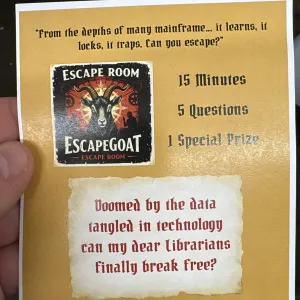
This is definitely one of the most interesting AI projects that I've been fortunate enough to work on! ScapeGoat, the AI Powered Escape Room for librarians, was demo'ed at the TLN Library Technology Forum in Michigan. This project was the brainchild of two former students of mine: Michael McEvoy of Northville [MI] Public Library and Shauna Quick, Library of Michigan. I helped with prompt design and providing the back-end infrastructure used to run the escape room game and scoring system!

This report contains a summary and literature review of reported AI-related mental health incidents from media sources in 2023 - 2025. These incidents are sometimes (unfortunately and inaccurately) referred to as "AI psychosis."

Public libraries in the United States are increasingly stepping up to address food insecurity in their communities, especially in the wake of the COVID-19 pandemic. Food insecurity – defined as the lack of consistent access to enough nutritious food – affects about 1 in 10 U.S. households, with rates nearly three times higher among low-income families 1 . The pandemic exacerbated this issue, creating what observers called a potential “hunger cliff” as emergency benefits ended 2 3 .

Public libraries can build strong board game collections by selecting durable, engaging titles across age groups (from simple kids’ race/matching games to teen-friendly strategy/party games and adult word, social, and classic tabletop options). The document recommends low-labor processing and practical maintenance—treat games as single “kit” items, reinforce boxes, store flat, use baggies/spare parts, and set clear circulation rules (shorter loan periods, holds, desk returns, and piece checks/fines for missing components).

Community engagement has emerged as a central theme in public librarianship, especially in recent years. Public libraries in the United States are increasingly expected to go beyond traditional services and actively collaborate with their communities to identify needs, co-create services, and foster social wellbeing. In the wake of the COVID-19 pandemic, social justice movements, and ongoing digital divides, libraries have redoubled efforts to engage their communities in meaningful ways.

Author's Note: This is one of those areas where information has both positive and negative applications. As a former elected library board member for almost a decade, I believe libraries should represent a wide spectrum of voices, perspectives, and experiences. In addition to being against any type of book ban, I always encouraged our library staff to select books from across the political spectrum, even from the end of the spectrum opposite mine. How do we ensure that our selection practices are fair and diverse if we don't measure the results?

In October [2023], we held a free beta workshop series for library grantwriters to test how AI can help write grants. In this article, we'll review some of the lessons learned and provide some sample prompts from our experiments!
General Guidelines for "Chat" AI Usage
Tools like ChatGPT, Bard, and Claude are a special type of artificial intelligence ("AI") that specialize in reading - and generating - human language. These types of AI are called "Large Language Models," or "LLMs."
As AI pragmatists and freedom-to-read advocates, yes, of course we all saw the headlines last week: "Iowa School Uses AI to Ban Books." If you somehow missed the story, it was covered everywhere from local media in Des Moines , education news , and even a brief article in
The Internet definitely changed how Readers Advisory is performed. Websites and services channel the preferences of millions of readers and book purchasers into a river of data. But the Readers Advisory librarian is still critical: instead of helping patrons navigate the stacks in a single library building, RA librarians now help patrons navigate the millions of items and thousands of review and recommendation sources available online. Learn more about our prAIrie Readers Advisory testing program!
The Internet definitely changed how Readers Advisory is performed. Websites and services channel the preferences of millions of readers and book purchasers into a river of data. But the Readers Advisory librarian is still critical: instead of helping patrons navigate the stacks in a single library building, RA librarians now help patrons navigate the millions of items and thousands of review and recommendation sources available online. Learn more about our prAIrie Readers Advisory testing program!
The Internet definitely changed how Readers Advisory is performed. Websites and services channel the preferences of millions of readers and book purchasers into a river of data. But the Readers Advisory librarian is still critical: instead of helping patrons navigate the stacks in a single library building, RA librarians now help patrons navigate the millions of items and thousands of review and recommendation sources available online. Learn more about our prAIrie Readers Advisory testing program!
My colleagues can confirm that I'm the first person to rave about how useful ChatGPT has been for my work. I've been using it since it became available for tons of everyday tasks: writing, coding, strategizing, brainstorming, and more. But a lot of the recent hype around AI tools, especially ordinary use of the basic ChatGPT system from OpenAI, really needs to be taken with a grain of salt!